
Introduction
Are you as interested in science as I am? I find myself going through science videos all the time on Youtube, on Tik Tok, and Facebook. I can’t seem to get enough. I just love science! The more far out a scientific discovery or theory is, the more fascinating I find it. But, I don’t want you to think that I accept all bleeding-edge scientific theories as fact across the board, because I don’t.
So I read about these theories and try to understand them, but I have to assign them to the category of “possible” until further evidence is found, hopefully through experimentation. Still, some of the more popular theories haunt me with questions like: What if the universe is a hologram? What if every choice I make spawns an alternate reality? What if information is as fundamental as matter? And many more.
These are big, complicated questions, not just sci-fi tropes, which is why they stick in my mind. But, of these questions, only one of them turns out to connect directly to what I want to talk about here, and that is the question about information. There is a growing scientific community that says to get at that question, you need a different kind of logic – not one based solely on what “is”, but on what “could be”. This is called counterfactual reasoning, and it’s the subject of this post.
For most of its history, physics has been built on equations that describe actual trajectories e.g., how a planet orbits a sun, how a particle scatters, how a field evolves. This is the science of “what is”, of “what is predictable”, and virtually all of physics operates according to these guiding principles.
Well, almost all. There is an exception, and it has been sitting in plain sight for over a century and a half. The second law of thermodynamics doesn’t predict a trajectory at all. Instead, it issues a prohibition, a clear “thou shalt not” that tells us you cannot build a perpetual motion machine, one that runs forever by extracting work from heat alone. Not “you probably won’t,” not “nobody has managed it yet,” but you cannot, ever, no matter how clever your design. Likewise, conservation of energy forbids a different sort of machine, one that makes energy out of nothing. It tells us that this ain’t ever going to happen! These are statements about what is impossible, and they are among the most reliable laws we have.
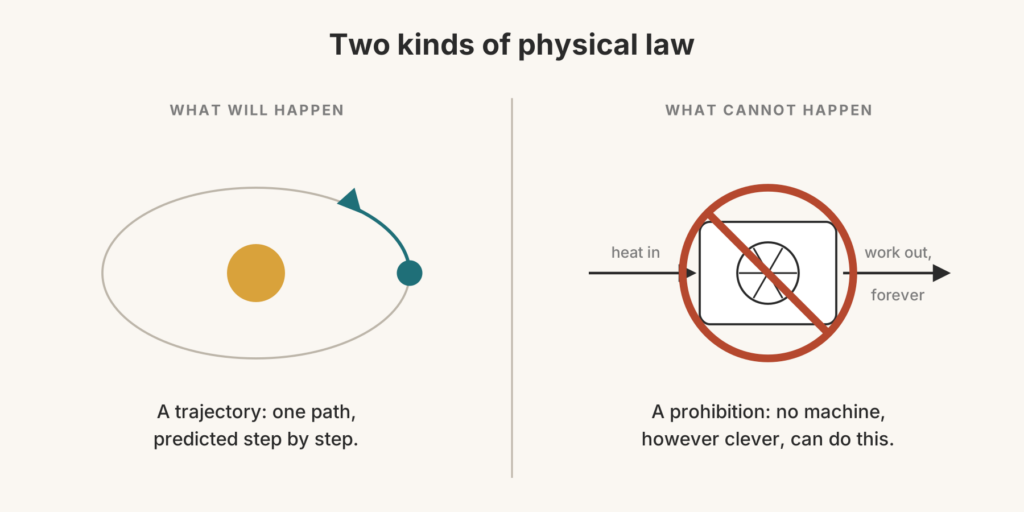
Physics has always treated these two cases as oddities. They are looked at as useful constraints, sure, but constraints that just happen to fall out of the real work, which is calculating what actually happens. So, here’s the question a small research program has been asking for over a decade: What if we have that backwards? What if statements about the possible and the impossible are actually fundamental to science, and the trajectories predicted by physics are what actually falls out of them? This question then gave rise to a program and they gave this program a name. It is called constructor theory.
Constructor theory was pioneered by David Deutsch (the father of quantum computing) and physicist Chiara Marletto. Constructor theory flips the script for physics! Instead of asking what will happen, it asks what could happen: which transformations are possible, which are impossible, and what principles decide the difference?
I know, this sounds pretty abstract, but lo and behold, it’s already bearing fruit. Constructor theory is being used to reformulate the second law of thermodynamics and reframe quantum information theory – all by focusing on something called counterfactuals: statements about what could happen, under what conditions, and why.
So in this post, we’re going to explore:
• What counterfactuals are (and why you already use them daily).
• How constructor theory uses counterfactuals to reframe the questions science is asking.
• And why this shift in thinking matters – not just for scientists, but for anyone who cares about knowledge.
What Counterfactuals Are and How They Are Used
I’m dating myself, but to me, the word counterfactual is a $5 word if there ever was one. Say it. It just sounds smart, right? But what does it mean exactly?
Counterfactuals can be defined as “what if” statements about a situation that didn’t actually happen, but could have happened if only one particular fact had been different. Confused? Bear with me as I drill down into its meaning.
Think of a counterfactual as a claim regarding an imagined alternative outcome to a particular real situation. While we use our imagination to come up with an alternative to a real situation, our claim about what that result would be is not imaginary, it is a real claim about the real world. (Remember that what is imagined must be physically possible to count as a counterfactual; after all, one could easily imagine a perpetual motion machine without there ever being a chance of one actually being created.)
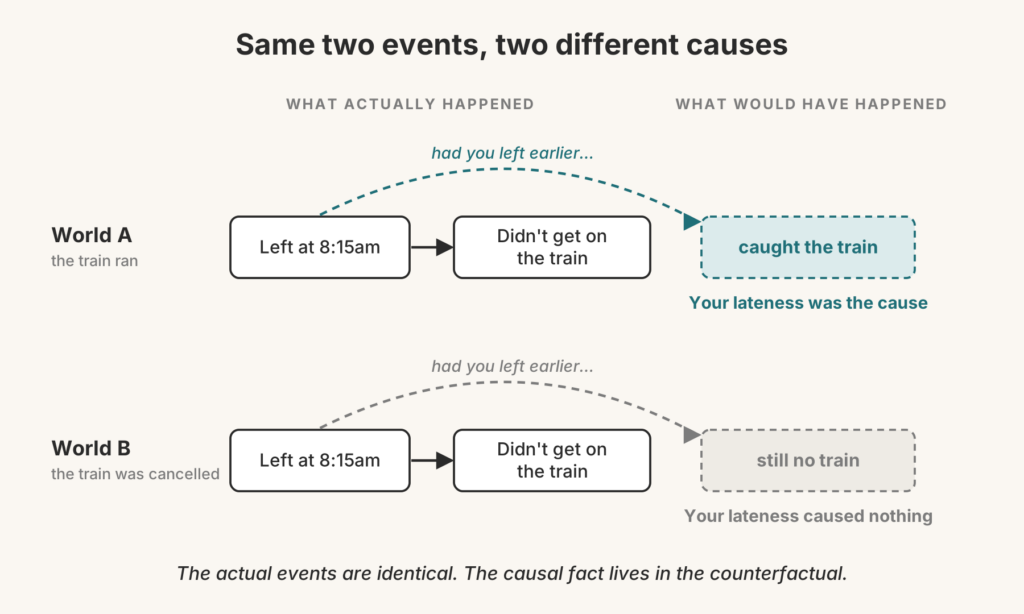
For example, consider this statement: “If only I’d left earlier than 8:15am, I wouldn’t have missed the train.” This is a counterfactual statement. It is either true or false and which one it is has nothing to do with how vividly I imagined the scenario. It depends on factors like how far I had to walk, the train timetable, on whether the train was running late anyway. Of course, if the train had been cancelled, the counterfactual is simply false no matter how plausible it feels. Thus, counterfactuals are not fantasies. They are claims that get their truth or falsity from the way the world actually works.
Here’s another counterfactual statement: “Good thing I brought an umbrella. If I hadn’t, I would’ve gotten soaked!” That you brought an umbrella is a fact. That you would’ve gotten soaked otherwise is the counterfactual. Hopefully, you’re beginning to see how counterfactuals are used every day, whether you know what to call them or not. This probably brings up other questions like, “What is their value?” To put it simply, counterfactuals are of value because they help us learn from the outcomes of different situations, understand their causes, and make better decisions.
In the second example involving the umbrella, the counterfactual helps sharpen our causal thinking by making it clear that packing the umbrella was a critical factor that helped avoid an unwelcome calamity. If leaving late cost you catching the train, then this points to a change you can make the next time.
The ability for counterfactuals to help with thinking about causes is clearly valuable once you consider it. The counterfactual states “If only I’d left earlier than 8:15am, I wouldn’t have missed the train.” But what if the train had been cancelled that morning? Where does that leave you? You still left at 8:15am and you failed to travel. But your statement that “I wouldn’t have missed the train,” is now false. Being late didn’t cause anything. You’d have failed to travel even if you’d have left an hour earlier.
So, in both scenarios the same two things happened: you left at 8:15am, and you didn’t get on the train. Yet in one case your lateness caused the outcome, and in the other it caused nothing at all. The causal fact isn’t in that pair of events, because the pair is the same either way. It lies in what would have happened had you left earlier i.e., the counterfactual. Thus, in the first world that counterfactual teaches you something, in the second world, it teaches you nothing.
How Counterfactuals Are Used to Reframe the Questions Science Is Asking
So far, every counterfactual I presented to you has been about single situations: this train, this umbrella, this morning. But some counterfactuals are much more ambitious. They don’t describe one missed train, they describe entire classes of things at once; for example, every machine that could ever be built, every process that could ever run, etc.
As a case in point, let’s return to the perpetual motion machine for a moment. When the second law of thermodynamics says you cannot build such a machine, take a look at the claim being made. It isn’t describing a machine that exists, because no such machines do. It’s a statement about what would happen to any such machine you could ever attempt to make, no matter how clever. This is a counterfactual exactly like the umbrella, just far grander in scope. The statement, “If you built it, it would fail,” gets its truth or falsity from the way the world actually works, precisely the same way “If I hadn’t brought the umbrella, I’d have gotten soaked” does. The only difference is reach. One is about you on a rainy Tuesday, the other is about the entire space of possible machines, forever.
And there it is. The thing that physics has largely overlooked. The second kind of counterfactual, the one that is about what is possible and impossible, has been treated as the unwanted stepchild of equations that predict trajectories. Yet, it may actually be more fundamental than they are. This is the wager that constructor theory makes.
I’ve been describing counterfactuals in the broadest sense: claims about what would or wouldn’t be true if circumstances were different. Constructor theory goes further and narrows that down to something more precise. It frames counterfactuals in terms of transformations; that is, whether a physical system can or cannot be changed from one specified state to another. To do that, it relies on two terms: event and task, and the easiest way to see the difference between them is with an example.
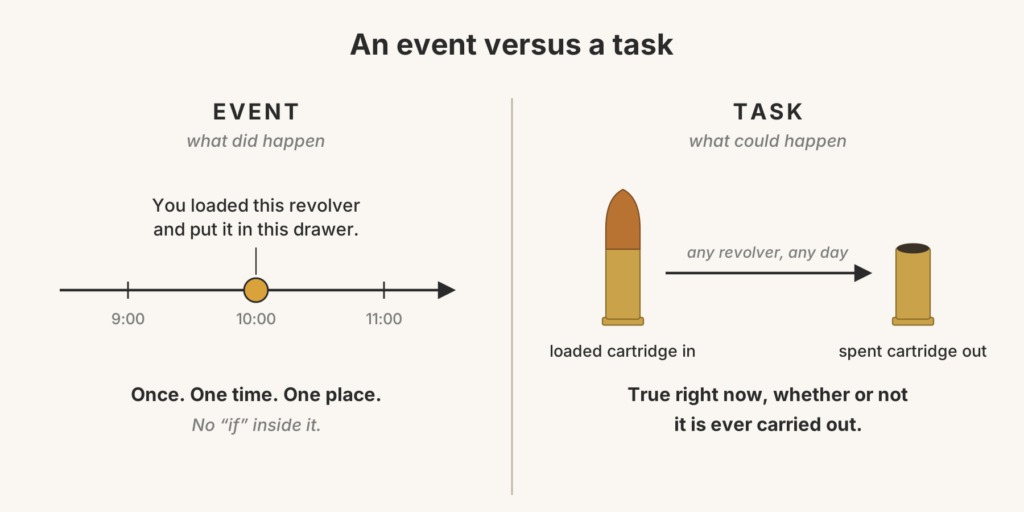
Let’s leave the trains and umbrellas behind for a moment and sit with something stranger. Picture this: at 10:00am you loaded a revolver and put it in a drawer. Nothing is moving. No trajectory is unfolding, no particle is scattering, no field is evolving. By the ordinary standards of physics, nothing is happening at all. And yet something is true of that gun right now that wasn’t true at 9:00am, before it was loaded: Now, if the trigger is pulled, it will fire. That fact is sitting there, doing real work, even though nobody has pulled the trigger and maybe nobody ever will.
Loading the gun at 10:00am is what constructor theory calls an event. It’s a plain, actual happening. Full stop. No hidden conditional lurking inside it, no “if this, then that.” It occurred once, at one time, in one drawer.
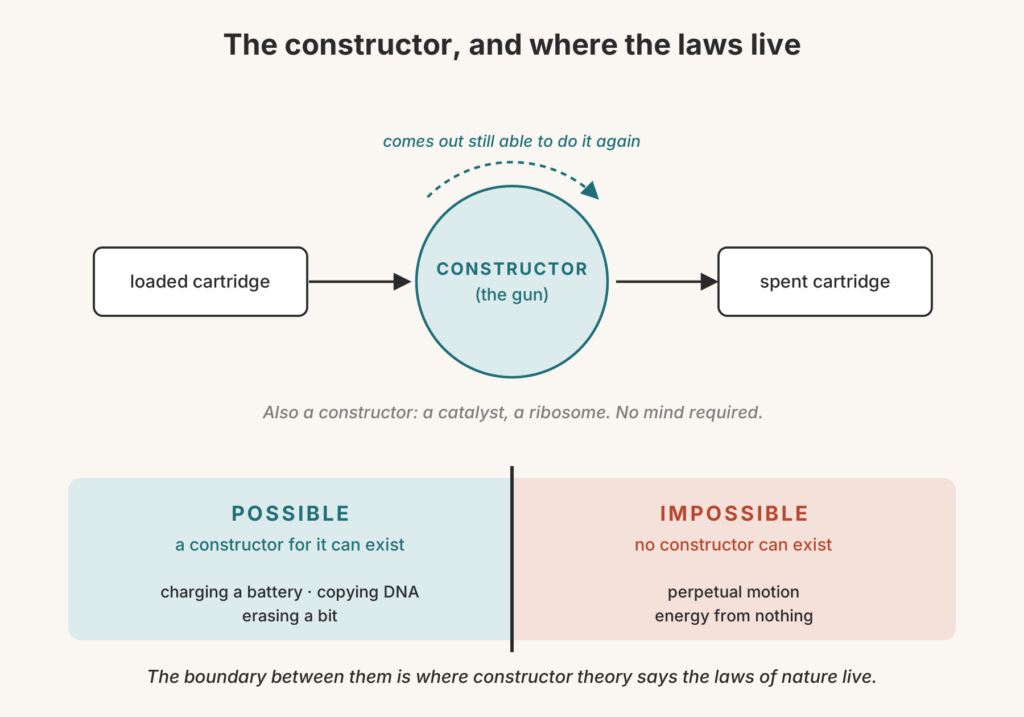
A task is something different. It isn’t a happening at all. It’s a transformation described in general terms, an input and an output: a loaded cartridge in, a spent cartridge out. Notice what’s missing from that description. It names no particular gun, no particular drawer, no particular morning. It covers this revolver and every other one, today and a hundred years from now. Charging a battery is a task. So is a particular chemical reaction, or erasing a bit of data from a computer. Each of these happens countless times, but the task itself is the transformation, not any single occurrence of it.
And here’s the crucial part. Whether a task can be performed is a fact about the world that holds right now, whether or not it’s ever actually carried out. The loaded gun in the drawer is capable of performing its task at this very moment, even if it never fires. So, an event describes what did happen, and a task describes what could happen. That “could” is doing all the philosophical heavy lifting.
Once you see the distinction, you can look back at the second law of thermodynamics with new eyes. Earlier I said it isn’t describing any machine that exists. Now we can say what it is describing: a task. The transformation a perpetual motion machine would perform cannot be brought about by any mechanism, however it’s designed.
Remember how physics has treated the second law as an oddity, a strange kind of law that doesn’t predict a trajectory the way the others do? With the task/event distinction in hand, it stops looking like an exception and starts looking like the clearest example of something physics has always had: tasks, hiding in plain sight, yet mislabeled as an oddity because nobody had the vocabulary to name what kind of statement it actually was! Conservation of energy works the same way. It isn’t a description of something that occurred. It’s a verdict on a task, rendered in advance, covering every instance of that task there will ever be.
This is the theoretical wager of constructor theory in full: the possible and the impossible aren’t leftover scraps that fall out of the equations describing trajectories. Instead, they’re the more fundamental layer, and the sought-after trajectories are what you get once you already know which tasks a given piece of the universe can and cannot perform.
Which raises an obvious question: does it matter who or what performs the task? Here constructor theory makes a move that’s easy to miss. You see, the thing that performs a task, which the theory calls a constructor, isn’t the person with their finger on the trigger. It’s the gun. Pull the trigger and the gun turns a loaded cartridge into a spent one, and afterward the gun is still there, able to do it again once reloaded. That’s what defines a constructor: it causes a transformation and comes out of it still able to cause it again. A catalyst in a chemical reaction qualifies. So does a ribosome building proteins in your cells. No mind, no person required.
And that gives constructor theory its sharpest idea of all. A task is possible if the laws of physics allow a constructor for it to exist, one that could be made more and more reliable without limit. A task is impossible if no such constructor can exist, however it’s built. The perpetual motion machine isn’t impossible because nobody has managed to build one. It’s impossible because the laws rule out any constructor for that task. That boundary, between the tasks the laws permit and the ones they forbid, is where constructor theory says the laws of nature actually live.
I have decided to include one more example of counterfactuals, this one taken from a distant chapter of my own life. I’ll be honest and tell you that I have struggled with the concept of counterfactuals. I’ve felt like I get it, but there’s always something missing, something not clear. This feeling melted away when I landed on the following example. It was like suddenly the light turned on and, for the first time, I felt that I was really “getting it.” So, in the off chance that you too are in the same boat that I was, I offer it here for you and hope that it will have the same effect that it had on me.
The scenario: The Central Highlands jungle of Vietnam in 1970. I am a member of a small group of soldiers proceeding through the jungle on our way to replace batteries in remote sensor devices near a place called, “Claymore Alley.” Suddenly the eerie silence of the jungle is split by the familiar sound of a claymore mine exploding, followed by human screams of intense pain and fright. Was this Claymore Alley living up to its name? The seconds tick by slowly as we all wait for the sound of gunfire, believing that we have walked into an ambush. Met by nothing more than the continuing screams, each man realizes that we’d walked into a mechanical ambush and that someone has tripped a booby trap which means the entire area could be mined. Lou, our sergeant, and I move toward the screaming soldier. Every step taken, every branch moved, could mean instant death. It was truly the longest 30 yards of my life.
In this scenario I just painted, what are the known facts and what is the counterfactual? Remember that a counterfactual is a claim about what would happen, or would have happened, if circumstances were different, and that its truth or falsity depends on how the world actually is.
The facts here are the men winding their way through the jungle, a known dangerous operation. This kind of danger was generally known and it was a given and accepted by all participants. All trails in the jungle were suspect and considered dangerous.
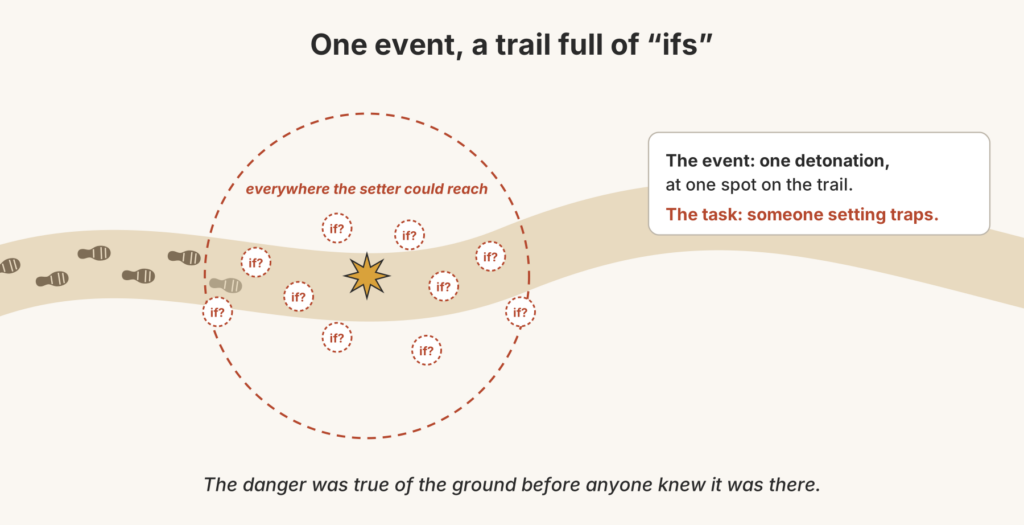
So what is the counterfactual here, the “if statement”? Perhaps you are tempted to think, as I did initially, that the counterfactual somehow popped into existence as a result of the soldier tripping a claymore mine. As I pondered my memory of this experience, I thought, “Aha! The explosion caused the jungle to change and become even more dangerous because now everyone knew the jungle was booby trapped!” But, the if statement I was looking for – If someone placed a foot there, a mine would detonate, did not just pop suddenly into existence, it was there, and true, all along. The jungle was just as dangerous before the explosion as it was a minute after.
Something important to point out here is that counterfactuals are facts about the world, not about minds. The danger was real before any of us recognized it. Recognition didn’t create this counterfactual, instead it allowed us to see it.
I don’t know about you, but this was a bit of a revelation to me. The lights had just turned on. I then moved from this celebratory experience to the question of value. “Cool,” I thought. “But what do I get out of knowing this counterfactual?” Do you see it? The counterfactual became a light beam penetrating the gloom of the jungle, the only real way any of us could eventually act on a danger we couldn’t see. Once we realized the trail was pock-marked with hidden “ifs”, every step we took became one choice among a sea of counterfactuals. “If I step here,” “If I step there,” “If I go to the wounded man this way, rather than that way,” was a deadly serious quandary. There was nothing visible to distinguish safe ground from deadly ground. The only navigation aid we had were the counterfactuals.
It’s true that the explosion of the mine detonating followed by screams of pain and fear were related to one specific spot in that jungle, a single event that happened. But this event led all of us that day to something larger: there is someone here who is building and setting booby traps. This activity described a task, one that can be repeated anywhere. One booby trap alone is evidence of a trap-setter, but a trap-setter in the jungles of Vietnam doesn’t just set one trap. Thus, the counterfactual spreads from one patch of ground to every patch of ground the setter could have reached! This realization isn’t a sign of panic, by the way, it’s just correct reasoning in action.
You might be thinking right now that this was an interesting story and helped clear up counterfactuals, but what has it got to do with physics and information? Think about it. A mine buried in a trail is exactly the same as a loaded gun in a drawer. Both are physical objects sitting perfectly still, with no trajectory unfolding, yet both carry a fact about what would happen if a certain transformation was triggered.
In this example, traditional physics of motion is used to describe a foot lifting and coming down, a detonation, shrapnel flying, etc. Constructor theory turns the priorities around. It says the deepest laws aren’t about how things move, but about what transformations are possible and impossible. Specific motions are what you get when you plug a certain starting situation into these deeper rules. Consider the claymore mine. There were no motions to speak of at all until the explosion occurred, yet the most important physical fact was already sitting still, waiting.
For those who may be wondering what happened to the wounded man in this tale, although wounded badly, we carried him to a jungle canopy opening that allowed a Medevac chopper to lift him to safety. He is alive and well. You can read about this specific experience in my article, titled “Claymore Alley.”
Why This Shift in Thinking Matters
At the start of this post, I mentioned a question that haunts me: what if information is as fundamental as matter? It’s time to come back to it, because everything I’ve covered so far turns out to be exactly what’s needed to make real progress on it.
Here’s the problem: Most of us think of information as something abstract, or as something that only exists when a mind is around to make sense of it. For example, to a bookshelf, a book full of information means nothing. And yet information clearly makes a physical difference in the world. Information is stored in computer memory, copied in our cells, sent across the planet through fiber optic cables. So which is it? Is information an abstraction, or is it physical? For most of its history, physics has had surprisingly little to say about this, because information isn’t a trajectory. You can’t write down an equation for how information orbits or scatters.
Like Leisure Suit Larry, forever looking for love in all the wrong places, we’ve been looking for information in the wrong place. Constructor theory says information isn’t a trajectory, it’s a counterfactual!
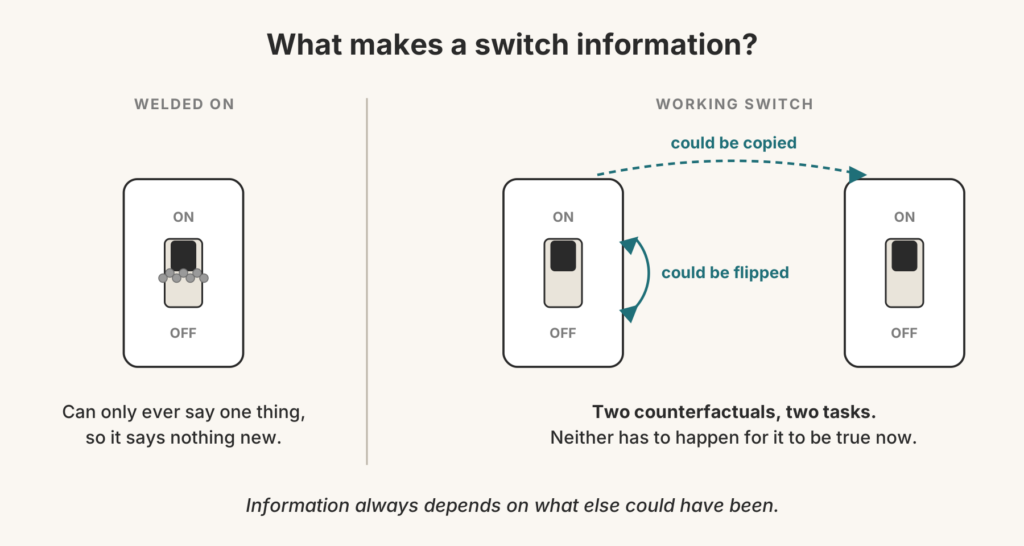
Consider an ordinary light switch. Right now, let’s say it’s on. What makes the position of that switch capable of being information? It isn’t the fact that it’s on. Imagine the same switch welded permanently in the on position. It’s every bit as “on,” but it can never be anything else, so from now on its position can never tell you anything new. Flip the circuit breaker, rewire the house, and the welded switch still says “on.” A signal that can only ever say one thing says nothing at all.
To be fair, the welded switch isn’t completely silent. If, at some point in its past, it could have been welded either way, finding it stuck on does tell you which way it went. But notice why: it’s informative about the past only because, back then, there was an alternative. It could have been welded off instead. Take away every alternative, past and future, and there’s nothing left for it to tell you. Information always depends on what else could have been.
So, what makes a working switch different? Two counterfactuals. First, the working switch could be in either position: on can be changed to off, and off to on. Second, whatever position it’s in could be copied into another system, a second switch set to match, say, or a relay that registers the first switch’s position and holds it.
Notice that both of these are tasks, not events. The switch never has to be flipped, and its position never has to be copied, for both to be true of it right now, exactly like the loaded gun in the drawer. And notice what’s missing: no mind is required. A cell copies its DNA without anyone reading it. What makes something information, according to constructor theory, isn’t anybody’s understanding. It’s which transformations the laws of physics permit.
That’s a remarkable shift. Information stops being a ghostly extra layer sitting on top of the physical world and becomes something physical in its own right, defined by what could and couldn’t happen. And notice one more thing: a copy is a relationship between two systems, not a feature of either one alone. That turns out to matter a great deal, but it’s a story for another post.
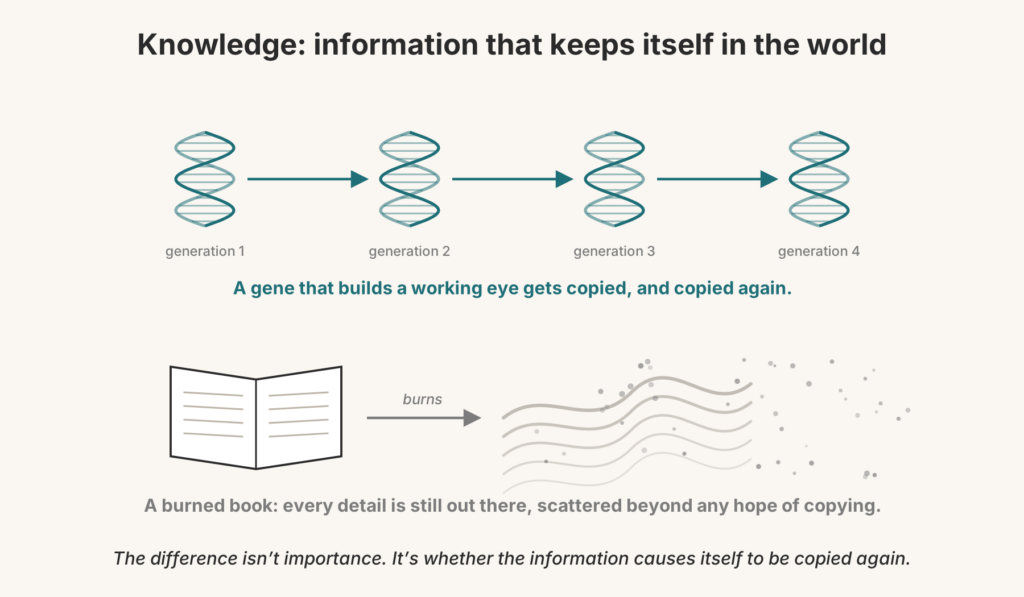
Still, information on its own is fragile. Switches get flipped. Copies degrade. Records burn. Physicists will tell you that, at the deepest level, nothing is ever truly erased; the details of a burned book are still scattered somewhere in the smoke and heat. But scattered beyond any hope of being copied again, they’re no longer of any use to anyone or anything. And yet some information doesn’t just stay intact, it seems almost to insist on staying intact, on surviving….
David Deutsch has a name for this kind of information: knowledge. Knowledge is information that, once it’s embodied in the right setting, tends to keep itself there. For example, a gene that builds a working eye gets copied to the next generation, and then the next. A burned book doesn’t. The difference between them isn’t how important the information is. It’s whether the information does something that causes it to be copied again.
Think back to that trail in Vietnam. Two bodies of knowledge met there. One belonged to whoever set the traps: where to place them, how to hide them, which paths men would take. It kept getting used because it kept working. The other belonged to us, passed from the old hands to every new arrival: how to walk the jungle, where to look, where never to put your foot. It survived because the men who followed it lived. Neither needed the jungle to understand it. Each one persisted for one reason only: it made a difference to what happened next.
Notice what both of these bodies of knowledge were made of. Not facts about what was happening, but facts about what would happen. If a trap goes here, someone will step on it. If you put your foot there, you won’t walk home. Counterfactuals, every one of them. The trap-setter’s knowledge and ours were both maps of the possible, and each survived because it was accurate enough to keep being used.
So, back to the question that haunts me: is information as fundamental as matter? I can’t tell you constructor theory has settled it. It’s a young program, and I still file it under “possible.” But it has changed how I ask the question. If constructor theory is right, information isn’t a ghost hovering over the physical world. It’s a counterfactual, a fact about which transformations are possible, and knowledge is counterfactuals that have found a way to keep themselves alive. That’s something physics can actually study. And it was sitting in that jungle in 1970, buried in a trail, long before I had a word for it.
There’s more to say, of course, especially about the idea that a copy is a relationship between two systems rather than a property of either one. Stay with me, because that’s where I’m headed next.
Discover more from Jeff Drake's Blog
Subscribe to get the latest posts sent to your email.